
Have you answered "what's the Wi-Fi password?" for the thousandth time? The information was in the house manual — but the guest didn't read it. And the problem is almost never a lack of information: it's the format.
"What's the Wi-Fi password?", "how do I turn on the oven?", "where does the rubbish go?". If you're a holiday rental host, you've probably answered those three hundreds of times — many of them late at night or during your downtime. Those questions, by the way, are always the same: see the 5 questions you should stop answering on WhatsApp.
Guests on holiday are lazy and don't want to read an encyclopedia in PDF form or flip through an old plastic binder. For your manual to be read, it needs to be designed for the TikTok era: fast, visual, and straight to the point.
The "instruction manual" mistake
The biggest mistake hosts make is writing the house manual like a legal document. Long texts, rules in all caps, and endless paragraphs create rejection. The traveller's brain blocks the reading and picks the easier path: sending you a WhatsApp message. To reverse that, apply the rule of scannability.

3 steps to a magnetic manual
1. Separate by moments (the guest journey)
Don't mix the pool rules with the Wi-Fi password. Organise the information by the moment the guest will need it:
- Arrival: door code, Wi-Fi, and where to park.
- During the stay: how to use the TV and air conditioning, pool and quiet-hours rules.
- Departure (check-out): where to leave the keys and the rubbish.
2. Swap text for images
If your induction cooktop or your smart lock is tricky to use, don't write three paragraphs. Take a photo of the device with an arrow pointing to the right button, or record a 10-second video with your phone. The brain processes images much faster than text. That care with equipment deserves its own attention: see how to guide equipment use.
3. Keep the rules positive
Instead of "NOISE IS FORBIDDEN after 10 p.m. under penalty of a fine," write "our neighbours wake up early for work; we kindly ask you to lower the volume after 10 p.m. so we can all get along." A friendly tone creates cooperation; an authoritarian one creates friction.
The digital guide revolution
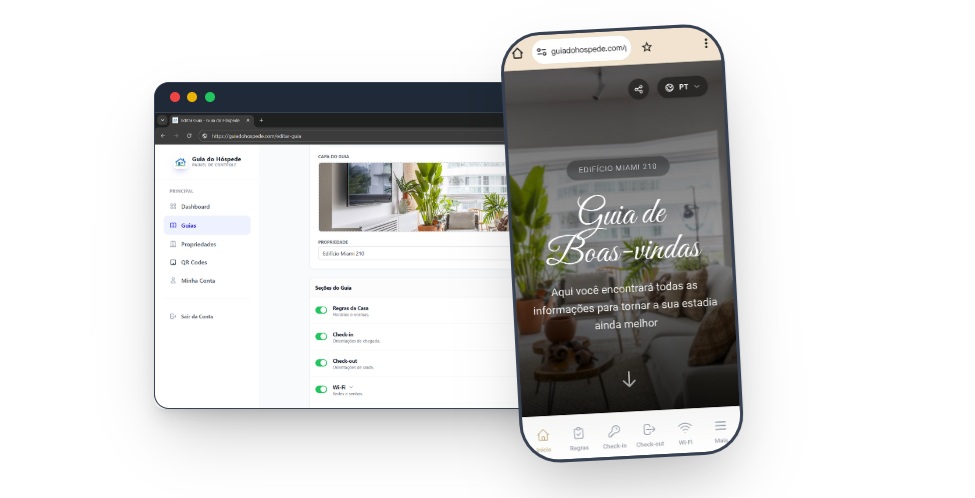
The biggest barrier of a paper or PDF manual is that the guest loses the file or isn't at the house when the question comes up. That's why professional hosts are migrating to digital guides. You send a simple link on WhatsApp days before check-in, and the guest opens the manual right on their phone, with no app to download — checking the door code from the car or seeing how to turn on the hot tub while out shopping.
A well-made manual isn't just a document; it's your best virtual assistant, working 24 hours a day for your peace of mind and for that 5-star review. If you still use paper, understand why digitising your rental matters.
Check out the demo guide from Guialo and see how this information reaches the guest in practice.
Frequently asked questions
What's the ideal length for a house manual?
There's no magic number of pages. The ideal is to cover everything the guest needs, but in a scannable way — divided by moments and with short sections, so they find each answer in seconds.
How do I get guests to actually read the manual?
Send the link before check-in, use short and visual language (photos and videos instead of long texts), and organise by moments of the stay. The easier it is to find things, the more they'll use it.
Does a PDF manual solve it?
Not really: the PDF gets lost in the chat and isn't practical to check on a phone when the question comes up. A digital guide with a link and QR code stays always accessible and updates in seconds.
Should I write the rules strictly?
No. Rules in a friendly tone generate more cooperation than prohibitions in all caps. Explain the why behind the rule — that's usually enough for guests to cooperate.


