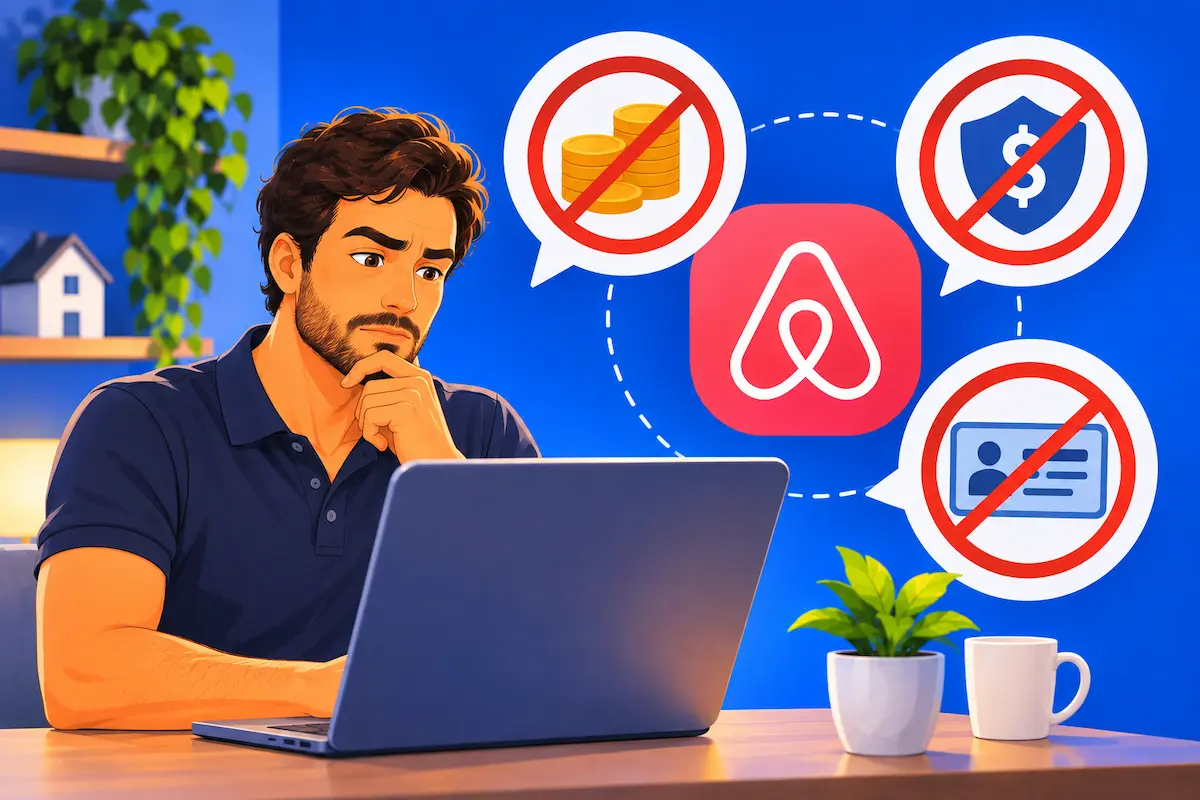
The Airbnb house rules policy that takes effect on 20 November 2026 had one half that was widely covered — the end of checkout chores — and another half that went almost unnoticed. It is the half that touches money and the guest's personal data: what you may charge, and what you may ask for.
If you have not yet reviewed the seven standard rules, start with what changes in the house rules from 20 November. This article covers the other half, which is the one that tends to end in a complaint and a refund.
The same cut-off applies: the policy covers bookings made on or after 20 November, not stays on that date.

Fines are gone
The wording is blunt: a host may not impose fines or other penalties on guests. That closes an entire practice a lot of people had written into their rules:
- a fine for smoking in the property;
- a charge for an undisclosed extra guest;
- a fine for a late checkout;
- a charge for a lost key or remote;
- a fine for a party or for noise.
Here is the distinction that saves you: a fine is not the same thing as reimbursement. A fine is punishment for breaking a rule, and that is over. Reimbursement is the real cost of real damage, documented — and that still exists, through the Resolution Center.
What you can still do when a guest breaks a rule:
- warn, in the designated section of the listing, about fines from a local authority — a building or council fine for noise is still the guest's;
- cancel the reservation without penalty to you;
- review the guest honestly;
- request reimbursement for the actual loss through the Resolution Center.
The surprise fee at check-in is over
Two sentences in the policy close that door. First: any fee for an advertised part of the listing must be included in the price shown to the guest at the time of booking. Second: you may not restrict access to any feature that is advertised as part of the listing.
In practice that rules out charging separately for the advertised parking space, for bed linen, for using the air conditioning, for heating the pool that appears in the photos. If it is on the listing, it is in the price.
What remains is legitimate and sometimes more profitable: an optional add-on, such as breakfast, a transfer or a bike rental, can be offered — as a request, not a rule, and without gating anything already advertised.
Security deposits: the thing few people know is that they were already barred
This one is not new in November, and it is the question that comes up most. Airbnb's rule already says that most hosts are not allowed to charge a security deposit or a credit card hold — neither through the platform nor outside it.
The exceptions are narrow: some software-connected hosts can set a deposit through the offline fees field, and hotels can place a card hold where the listing discloses it. Beyond that, taking a deposit off-platform is a rule break, not a precaution.
What replaces the deposit is AirCover for Hosts, with the reimbursement request filed in the Resolution Center within 14 days of the responsible guest's checkout. Document it on the spot: photos, video, and a repair or cleaning estimate.
The guest's ID: the most sensitive part
This is the change most people will find out about too late. Airbnb now bars a host from soliciting the guest's personal information, and the list is explicit: passport, driving licence, document number, a photo of the document.
What stays allowed is narrow and conditional: checking the ID in person at check-in, provided the requirement is disclosed in the requests section of the listing — and without keeping a copy, digital or on paper.
Also barred: financial data (card number, bank account), background checks and credit history.
There is an exception, and it matters: where the law requires it, where there is a documented community association rule, or where it is needed to sign a permitted contract. In those cases collecting is still valid, but Airbnb now expects three things — say on the listing what you collect and why, collect no more than you need, and store and dispose of it securely. And Airbnb may ask for evidence that the exception applies to you.
If your city or country requires guest registration with the authorities, that is the exception that covers you. It is worth checking the local rule and writing the reason into the listing, rather than asking for a photo of the document over WhatsApp.
Contracts: four cases, and the document is public
A separate contract is only permitted where it is required by law or by a community association rule, where it gives access to an optional amenity, where the stay is 28 nights or longer, or on Airbnb Luxe listings.
Two details change what you write in it: the contract is publicly visible on the listing, so it cannot contain anyone's personal data; and you collect the signature yourself — Airbnb does not require guests to sign and does not help enforce it.
What the guest is still obliged to do
This part is barely discussed and it is the reassuring one. The ground rules for guests still stand, and they are not trivial:
- leave the place in a state that does not require excessive or deep cleaning;
- put rubbish in the designated bins;
- respect quiet hours;
- respect the approved number of overnight guests — and disruptive gatherings are always prohibited;
- tell the host as soon as there is damage, and pay reasonable reimbursement where they are at fault;
- disclose a pet when they bring one.
In other words: you lost the fine, you did not lose the right to a cared-for home. The cleaning fee covers standard turnover cleaning, not deep cleaning after carelessness — and that is Airbnb's own position.
The new consequence: search visibility
It is worth understanding what happens to hosts who do not adapt, because the enforcement goes further than a warning email. The ladder is: education, a request to update the listing, a warning, a notice on the listing flagging the issue to guests, and reduced visibility in search.
That last one is what hurts revenue. It is not a block; it is slowly disappearing from results — the kind of problem that sends no notification and shows up only as a drop in bookings.
A checklist before 20 November
- Search your rules, your saved messages and the signs on the wall for the word "fine". Delete every one.
- List the fees you charge separately. Anything tied to an advertised feature goes back into the nightly price.
- Stop asking for a photo of the ID before arrival. If you check it at check-in, disclose that in the requests section and keep no copy.
- If local law requires registration, write on the listing what you collect and why — and keep proof of the requirement.
- If you take a deposit off-platform, stop. Replace it with AirCover and the habit of documenting the state of the property.
- Check that your contract falls into one of the four cases, and strip any personal data out of it.
Without fines, what is left is what actually worked
It is worth facing the practical effect: the policy took the punishment tool away from hosts. What is left to protect the property is making the right behaviour the easiest one — and that is not a consolation prize, it is what worked better anyway.
A fine for a lost key never prevented a lost key; a clear instruction on where to leave the key does. A charge for an extra guest never prevented an extra guest; the number on the listing and a note that the building has a front desk does. It is the difference between punishing afterwards and guiding beforehand — and guiding beforehand is exactly what a guest guide does, including for the equipment.
See the demo guide and notice where the instruction replaces the punitive rule.
Hosts whose listing was already honest about price and whose guide was already clear about instructions will barely notice. For anyone who relied on fines and deposits, November means rewriting — with the usual side effect, fewer repeated questions on WhatsApp.
Frequently asked questions
Can I still charge a fine for smoking in the property?
No. The policy prohibits imposing fines or other penalties on guests, and it applies to bookings made on or after 20 November 2026. What remains possible is keeping the no-smoking rule on the listing, cancelling the reservation without penalty if it is broken, reviewing honestly, and requesting reimbursement for the real damage — for example the extra cleaning of curtains that smell of smoke — through the Resolution Center.
What is the difference between a fine and a reimbursement request?
A fine is a fixed amount charged as punishment for breaking a rule, and that becomes prohibited. Reimbursement is the real cost of a real loss, evidenced with photos and an estimate, requested in the Resolution Center within 14 days of checkout. The practical difference is that reimbursement needs damage; a fine only needed the rule.
Can I still take a security deposit from the guest?
In most cases no, and this was already the rule before November: most hosts are not allowed to charge a security deposit or a card hold, either through the platform or outside it. The exceptions are some software-connected hosts, who set it through the offline fees field, and hotels that disclose a card hold. Damage protection comes from AirCover for Hosts.
Can I ask for a photo of the guest's ID before arrival?
No. Airbnb now bars hosts from soliciting personal information such as a passport, driving licence or a photo of the document. You may check the ID in person at check-in if you disclose that in the requests section of the listing, and keep no copy. Where local law requires guest registration, the legal exception covers collecting it — stating what you collect and why, collecting the minimum, and storing it securely.
Can I charge separately for the parking space listed on my ad?
No. Any fee for an advertised part of the listing must be in the price shown at the time of booking, and you may not restrict access to anything advertised. A separate charge is only valid for a genuinely optional add-on, such as breakfast or a transfer, that was not included in the listing.
What happens if I do not comply?
The ladder of consequences runs from education and a request to update the listing through to a warning, a notice on the listing flagging the issue to guests, and reduced visibility in search. The last is the most serious for revenue, because it sends no notification: it shows up as a drop in bookings.